
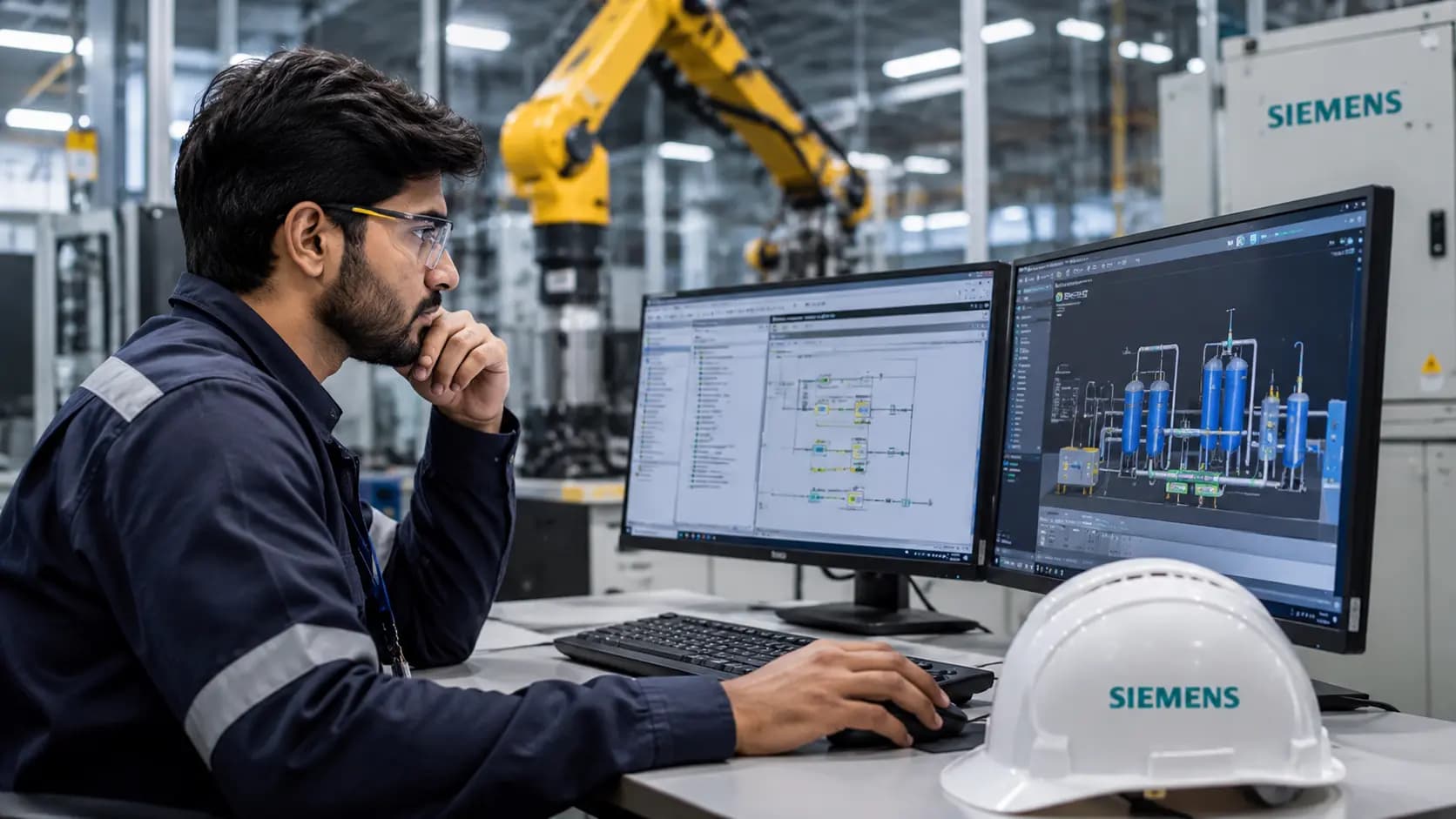
Siemens has launched its Eigen Engineering Agent in India, introducing an artificial intelligence (AI) solution designed to automate complex industrial engineering tasks. The technology aims to help manufacturers and engineering teams perform activities such as programmable logic controller (PLC) coding, human-machine interface (HMI) visualisation and device configuration with greater speed and efficiency.
The launch marks a shift from AI tools that primarily generate recommendations to systems capable of carrying out multi-step engineering tasks. Siemens has already successfully piloted the Eigen Engineering Agent with more than 16 customers across India. The company announced the launch during its seventh Transform – Siemens India Innovation Day in New Delhi.
How Eigen Engineering Agent Works
Unlike general-purpose AI assistants, the Eigen Engineering Agent is specifically designed for industrial automation environments. It operates within engineering systems and considers individual project requirements, technical constraints and existing configurations before carrying out tasks.
The agent uses multi-step reasoning and self-correction to complete engineering workflows. Its capabilities include generating PLC code, creating HMI visualisations and configuring industrial devices. These activities are important in manufacturing facilities where automated systems control machinery, production processes and equipment operations.
Siemens says the technology is designed to meet industrial requirements for correctness, safety and reliability. By handling repetitive engineering activities, it aims to allow engineers to spend more time on complex system design, problem-solving and innovation.
Siemens Reports Improvements in Engineering Efficiency
According to Siemens, the Eigen Engineering Agent completes AI-powered workflows two to five times faster than manual alternatives. The company also reports up to 80% higher solution quality and 50% greater engineering efficiency.
These figures are based on Siemens' reported performance comparisons and should not be interpreted as guaranteed improvements for every industrial project.
The company believes the technology could be particularly useful for small and medium-sized manufacturers that operate with limited engineering resources.
Automating repetitive tasks may help these businesses manage complex automation projects without significantly increasing their engineering workload.
Sunil Mathur, Managing Director and Chief Executive Officer of Siemens Limited, said India's next manufacturing phase would depend on productivity and quality alongside cost competitiveness. He highlighted the importance of extending automation across the manufacturing value chain, particularly among small and medium enterprises.
Indian Manufacturers Already Testing the Technology
Siemens has identified Pelican Rotoflex Pvt. Ltd., a manufacturer of printing and converting machinery for the flexible packaging industry, as one of the Indian customers using the Eigen Engineering Agent.
The company has integrated the agent with Siemens' TIA Portal engineering environment. The integration supports code generation, documentation, code interpretation and targeted issue resolution.
These capabilities are intended to reduce repetitive engineering work, help customize machinery faster and improve productivity during automation software development.
Another customer, Z System Intelligent Controls, has used the technology for PLC code understanding, logic generation, validation and automated documentation.
According to Siemens, the company's AI-assisted engineering approach can reduce repetitive engineering effort by more than 50%, improve productivity by 20–30% and shorten development and commissioning cycles in relevant applications.
These examples demonstrate how industrial AI can be integrated into existing engineering workflows rather than operating as a separate general-purpose chatbot.
Industrial AI Takes Centre Stage at Siemens Innovation Day
The Eigen Engineering Agent was among more than 40 industrial AI innovations showcased at the seventh Transform – Siemens India Innovation Day. Organised under the theme "AI for the Real World", the event brought together approximately 500 industry leaders, customers, policymakers, technology experts and ecosystem partners.
The event focused on how AI, digital twins, industrial automation, software and electrification can help Indian businesses improve productivity, operational resilience and energy efficiency.
Siemens highlighted the importance of applying AI to practical industrial challenges, including manufacturing processes, infrastructure development and energy management.
The company's approach reflects a broader shift in industrial technology, where AI is increasingly being integrated into engineering systems, production environments and business operations.
What the Launch Means for India's Manufacturing Sector
India's manufacturing industry is investing in automation to improve production efficiency, maintain quality and manage increasingly complex industrial operations. However, engineering teams often spend considerable time on repetitive activities such as programming, documentation, configuration and system validation.
AI-powered engineering tools could help address these challenges by automating selected tasks and reducing the time required to complete projects. For smaller manufacturers, this could provide access to advanced engineering capabilities while allowing existing teams to concentrate on higher-value activities.
The introduction of the Eigen Engineering Agent in India also highlights the growing role of industrial AI in the country's manufacturing transformation. Its adoption will depend on how effectively it integrates with existing systems, meets industry safety requirements and delivers consistent results across different engineering environments.
As manufacturers continue to modernise their operations, AI agents capable of performing practical engineering tasks could become an important part of industrial automation. Siemens' latest launch represents another step towards bringing these capabilities into everyday manufacturing workflows.
Source:- Siemens